Wednesday, January 14, 2015

At First Blush


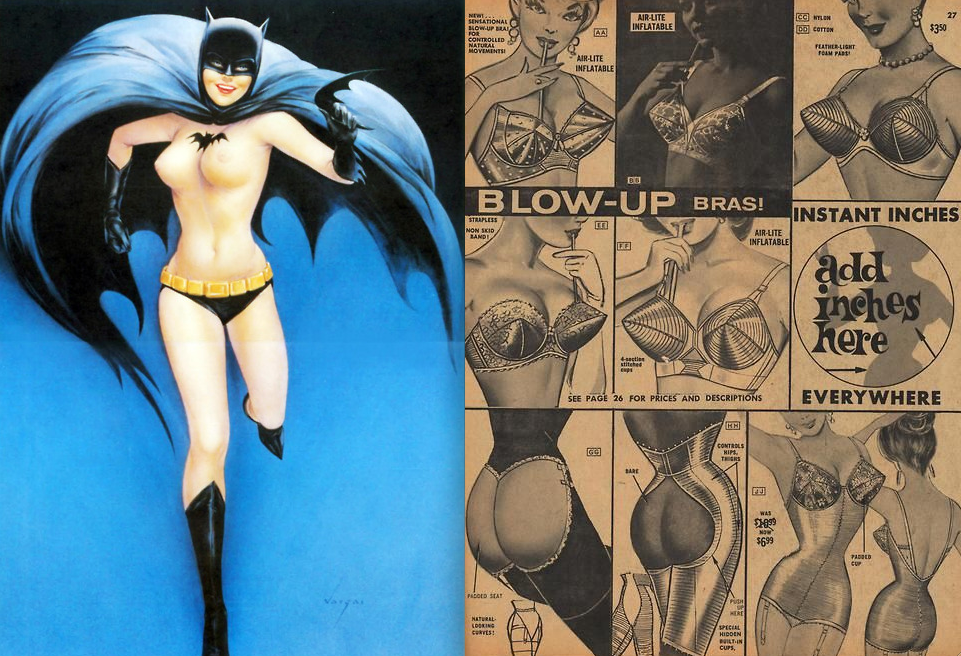
     Like most American boys of mid-century vintage my first exposure to images of the naked breast probably came through the pages of The National Geographic Magazine. This would have come before stumbling upon Art Treasures of the Louvre or even noticing the endless stream of figure drawings and paintings my mother brought home from the Art Students' League. Being the often emaciated chest of some far-flung and culturally unfathomable tribeswoman, these images were of some anatomical value, perhaps, but were less satisfying to the imagination than even the deftly rendered lingerie ads in the column breaks of the Daily News. When, a year or so later, I came to understand that a real artist drew naked ladies because that's what artists do, I would spend hours alternately copying the anatomically overwrought nudes of Michelangelo and da Vinci and the relentlessly perky and uplifting illustrations from the papers, often winding up with something along the lines of a muscle-bound, trans-gendered and be-tittied Batman.


   The true epiphany as to how fundamentally important the bosom was to the making of art dawned on me with the discovery of the legendary Land O' Lakes Indian Maiden Trick, wherein, with a bit of old-school cutting and pasting one could make real art out of a butter box. Possessed of a set of knees so transfigurative and peerless, the Indian Maiden could be fleshed out in a few minutes, becoming a pretty respectable if somewhat idealized depiction of the unveiled form, and was certainly more artful and anatomically correct than anything resulting from the famous Pep Boys Matchbook Trick.


   A few years later, walking home from school, I stumbled upon a battered trash can overflowing with Playboy magazines from the late 50's and early 60's. I stuffed as many as I could fit into my book-bag and snuck them into the house for further perusal. The pin-ups and photos in Playboy were still comparatively chaste in those days and focused primarily on the torso; indeed, most of the featured Bunnies wore toreador pants or pleated, cheerleader skirts while flaunting their assets. Maybe it was the soft focus or the photos' inherent lack of definitive line, but I could never seem to make a satisfactory copy from these shots. Turning a page one day I came upon the drawings of Alberto Vargas and that changed everything. I found that by carefully tracing the monthly Vargas Girl, transferring that to a piece of shirt cardboard and working it over with colored pencils, I was well on my way to creating a pretty good facsimile. 


   The first of these drawings I brought in to school and furtively shared with a few of my fellow Fifth Graders caused quite a sensation, nearly attracting the attention of Mr. McNought, a fiery Welshman who would certainly brook no smut in his classroom and was not above the use of corporal punishment. After school, though, while waiting for the downtown bus, a large group of boys who had heard rumors of this exciting new development clustered around for a peek, and it was only a matter of moments before I found myself taking orders at twenty-five cents a pop. For the rest of that year I could barely keep up with the demand for ersatz Vargas Girls and before long had abandoned the tracing bit altogether and found my skills at copying these in freehand – even venturing out with a few, sort of composite originals – had vastly improved.


In time I eventually sat before live models and was surprised to discover how almost immediately run-of-the-mill the whole naked lady experience turned out to be. Drawing the figure from life and getting it right was often pretty grueling and frustrating work, leaving little room for titillation, and where I might have been shocked, at first, to find that naked men engaged in this work as well, I grew to accept, over time, that no one who looked like a Vargas Girl or even the Butter Maiden was ever going to climb atop that dais.

Wednesday, January 7, 2015

The Best Artist


      Oliver was the first Artist I ever hung out with. A slender, freckled wraith of a boy, Oliver sported a clown-like head of curly red hair atop which he affected a noodled beret, round wire-rims and some sort of scarf or ascot he'd filch from his parents' closet for the occasional salons he'd subject me to by way of play-dates in his family's huge apartment. If, at the age of nine or ten, Oliver had been able to complete the image with a jaunty Van Dyke, I'm sure he would have, and the relative pros and cons of removing an ear for authentic effect was a frequent topic of discussion on these strange afternoons. He never wore the ascot and beret at school, where such sartorial overreach would have required having the crap beaten out of him, but in the privacy of his own home, before an uncomfortable audience of one, there seemed to be no limit to his efforts to channel some bygone denizen of La Vie En Rose.


  Where Oliver came by this insight into late Nineteenth Century bohemian culture is a mystery; his parents, I think, were archeologists or anthropologists and were never home. Their apartment was decorated with an array of small pedestals upon which fragments of apparently ancient sculptures and pottery shards were displayed, the walls hung with prints and paintings that seemed modern and important to me, though they weren't to my taste and I knew very little about art beyond what I'd picked up from my mother and her friends. A maid usually let me in and Oliver, in full regalia, would lead me to a sunny portion of the living room where he might have Scotch-taped his own pictures to the wall, floor to ceiling, for us to “critique”. These efforts were about what you'd expect from any third grader: partially fleshed out stick-figures, cockamamie street scenes, landscapes with dragons or horses, with the occasional half-baked, fruit-bowl still life thrown in for professional effect. It seemed important to Oliver that we engage in some sort of quasi-formal discussion about his pictures and I would squirm and struggle for anything at all to say. If these sessions made me uncomfortable, they paled in comparison to those afternoons when Oliver would set up an easel and stool, don a powder blue smock and insist that I sit for a portrait. Assuming the position, eyes asquint, kidney-shaped palette in hand, he might make the requisite, ridiculous gestures with thumb and forefinger before commencing on what, invariably, came out looking more like Oliver himself – or a bowl of fruit – than me. Creepy as this performance was, I would sooner or later get the giggles; Oliver would puff up in a sort of mock tantrum, rip the paper from the easel and demand I take a turn while he sat, which did little to curb my cackles.


   One sunny afternoon while we sat drawing side by side at the coffee table, Oliver suddenly stood up, strode over to the wall and took down a Picasso bullfight lithograph. “Watch this.” He said, prying the backing off the frame and removing the print. Brushing aside our clutter, he lay the litho down on the smoked-glass table, grabbed a pink eraser and, with the tip of his tongue protruding slightly from the corner of his mouth, proceeded with vigor to erase Picasso's penciled signature and, upon that now smudged and sullied spot, signed the thing with “Oliver”. Even then – without fully comprehending either the value of a Picasso or any distinction in provenance between signed prints or the stuff you'd buy at the museum gift shop - I knew this was some sort of major sacrilege. I was stunned by the hubris, the monumental narcissism required for such blasphemy. “I am the best Artist!” Oliver bellowed as he replaced the print in the frame, hung it back on the wall and withdrew a few feet to admire his work. I remember feeling shame and confusion; I couldn't make eye contact with Oliver or look at the wall. Instead, I focused on the tiny pink detritus from the eraser, now tangled in the white, shag rug. I don't know what the consequences of that afternoon were. I don't remember hearing of any punishment or censure, and, though I'm sure I continued to visit his apartment over the ensuing years I can't recall looking at the wall or seeing the print again. I don't know what ever became of Oliver. At one point, decades ago, I'd heard he'd become an actor with a role as the nerdy side-kick in a popular coming-of-age movie.


   For most artists, I think - the painters, the poets, the writers, certainly – creating the thing is a lonely affair, fraught with doubt and struggle and invariably, in the end, less than satisfying. Toiling in obscurity, a little narcissism and hubris go a long way towards keeping you in the game and may just make you a star. Just ask Picasso.


Saturday, January 3, 2015

Self On A Shelf


I'm not a Christmas person. After the age of about twelve I began to notice the various stresses and anxieties attendant to the approach of the big day, often punctuated by escalating outbursts and explosions on the part of my father, who had a short fuse and was quick to boil over in pursuit of the perfect Christmas Morning. Despite a few scars along the way, though, those mornings did turn out to be pretty perfect; Dad decorated the tree - it was best to leave that to the precision of his architect's eye and not get in the way – as well as the rest of the house with votives and garlands, fir bows and hand-cut snow flakes, vintage music boxes that played “Fly Me To The Moon” and “La Vie En Rose” in a sort of endless cacophony, gradually diminishing to a single note. He carefully arranged the ancient, Italian nativity scene in the bee-hive oven of the big brick fireplace, placing the creche just so on a bed of straw beneath a flock of tiny, blue clay angels he'd rigged to fly long ago from a piece of wire coat-hanger. After decanting our stockings, we would pause for an endless interval while Dad made sugared grapefruit halves, scrapple, English muffins and slow-scrambled eggs before heading back in to the living room to open an embarrassing abundance of presents for which none of us felt particularly deserving after a week or so of pitched battles and high anxiety. Suzanne and Zinzi adore Christmas and strive for that perfection while I invariably trip over my legacy and screw it up, sooner or later, somewhere along the way.


   Not that my malaise is all Dad's fault. Those years in the Eighties jumping slush-puddles at crowded cross-walks and stuffing myself into packed and reeking subway cars just to wind up in Macy's Basement, Tower Records or – in complete and abject desperation – Azuma's, seemed cold, frustrating and thoroughly unsatisfying. Elbowing through the mob to the display table and pawing over yet another Chemex or pasta machine or fondue set or quiche pan or coffee grinder, when none of these things was even remotely good enough for anyone I was shopping for left me, hours later, dark, brooding and empty-handed with the clock still ticking. The worst gift I ever gave was a ratchet screw-driver I picked up on Canal Street for my Dad; my only defense being that ratchet screw-drivers were something of a novelty then and seemed to me at the time to be more useful than that set of demi-tasse you've all got hidden away in the cupboard over the microwave.


The best gift I ever gave was a gift-wrapped bottle of Courvoisier that had been turned down by a waitress I'd been chasing at Fanelli's. Despondent over her rejection, I determined to hand it off to the first person I saw after leaving the bar. This turned out to be a Mr. James Aloysius Finbar McTavish, a tipsy gentleman who lived on a scrap of packing-crate in the bowels of the Broadway-Lafayette F Train stop. Some months earlier I had passed McTavish tussling over a bottle of something with one of his compatriots in the dark and dismal mid-ships of the station. The other fellow kept bellowing, “ Gimme that bottle, McTavish!” and McTavish shouted back, “ On the sacred name of me dear departed, James Aloysius Finbar McTavish will never surrender this bottle to the likes of you....!”  Of course, this little bit of urban theater stuck with me so that, when I came upon McTavish that sad night I was able to extend the gift-wrapped offering to him with a simple, “Here, McTavish. Merry Christmas....”  and wander away towards the platform with his astounded retorts echoing in the dark and fetid chamber. “Wait, wait,” he bellowed, “ How'dya know me name, Mister? Who the Hell are you? James Aloysius Finbar MacTavish thanks you! Me sainted mother thanks you! May the Saints preserve you and keep you....” He trailed off, drowned out by the arrival of the train.


I'm not much of a New Year's Eve person, either. My friend John's father, by all accounts a world-class inebriate, dubbed this “Amateur Night” and recommended drinking at home for the occasion. Certainly after a few such evenings spent stepping around the puking Bridge and Tunnel set outside McSorley's or worrying at the giddy girl, chartreuse tiara askew, being carried off by a few good men, it's best to be off the streets unless you have a pretty good place to go. My father loved a party, despite his grouchy demeanor, and would throw a good one. These were more fun than Christmas and whether they involved Twister and Cold Duck or transforming the house into some tropical paradise via weeks of papier-mache, the whole neighborhood would show up for a good time, usually culminating with Dad at the piano singing holiday favorites accompanied by one of our pistachio-stuffed Labradors.


   The best New Year's Eve party I ever went to was actually a series of events on the side streets of Soho in 1981. We'd left our sublet in some Mercer Street basement just to see what was going on and immediately got swept up in a sort of Conga-line of revelers threading their way from party to party throughout the neighborhood. No one appeared to have been invited to any of these loft-parties, we just followed the crowds up one flight of stairs while those descending called out the addresses of other hot prospects around the corner or down the street. Groaning boards of ham and champagne greeted us at every turn and no one turned us away. Celebrities were everywhere, Mary Boone, Keith Haring, Andre, Bobby De Niro – everyone in Soho called him Bobby – mixing happily with the common folk as we all tooted on those ubiquitous, unfurling whistle-things. At one point I found myself in line on the stairs behind William S. Burroughs, another renowned dipsomaniac, who smelled like stale piss and was apparently as much of a free-loader that festive night as we were. Oddly, I would find myself in line behind the stinky Burroughs on two or three other occasions over the coming years.


   As for the whole resolution thing, they've rarely worked out. I've lost a few pounds now and again, quit smoking for a minute or two once or twice and, given that I seem to have inherited all my Dad's uglier qualities with few of his virtues, resolved year after year to be a better, more tolerant and forgiving husband and father without much success and a long way to go.


   So Happy New Year, dear reader, may you find and spread tolerance and forgiveness throughout your travels.....

Thursday, December 18, 2014

The Pope Knows Cuba (e Cani) Libre


    Pope Francis, bless his soul, has recently been reported to have instructed Saint Peter to begin allowing dogs through the Pearly Gates. Although this dogmatic shift may actually be attributed to Paul VI, and there's no sign yet as to whether the decree is retroactive, it's nice to think, assuming they predecease us – which, actually, may be something of an assumption indeed – that our current flock of Goldens will not only have a shot at finding their bliss but will be eagerly awaiting our arrival. Presumably this was not as thorny an issue as, say, women in the priesthood and the new rule doesn't seem too much of a reach given that God's Rottweiler, Pope Benedict, has yet to drop the bone and is waiting in the wings.


Having been raised a Presbyterian, I was unaware that dogs had thus far been barred and grew up with the notion that all God's creatures might gain entry based entirely on a bronze plaque commemorating the scene wherein Heinz, my parents' beloved first mutt, is negotiating with Peter just outside the heavenly portals. This plaque was made by my Godfather, the sculptor Berthold “Tex” Schiwetz, a pious enough man devoted to years of religiously sculptural epiphany in Rome, who went off to his own reward in 1971. Whether or not Heinz, or Tex, for that matter, is still waiting at the gates is something I suppose that only God knows. In perhaps a divinely inspired gesture from the family, the same plaque now adorns my mother's headstone and there's no question as to whether or not she got in.


   The fact that none of our pets have been going to Heaven for all these years does make one wonder how bad, in fact, the alternative can be. Apart from all the priests that have found their way to Hell in recent decades and are now busy making everyone down there miserable, if the place is primarily populated by non-Catholics and their pets - together, presumably, with all creatures great and small – maybe it's not much worse than Southern California in September. If Heaven is reserved for pious, petless fussbudgets and proselytizers, then I want no part of it and I'll go straight to Hell.


      As I write this Pope Francis is suddenly all over the news and I'd be the last one to have predicted the two of us would ever be so simpatico, even for a day. Apart from being the Holy Birthday, it turns out this progressive Pontiff has been up to his zucchetto in the sort of Geo-politics and international intrigue not seen since the House of Borgia installed one of their own. There's something deliciously ironic about Pope Francis helping to broker the end of our pointless policy towards Cuba, a policy that began at about the same time that our only Roman Catholic President was elected despite the clamor and conviction of the Right that Kennedy's first and last allegiance would be to Rome!


 Buon compleanno, Papa, e grazie mille!

Friday, December 12, 2014

Mail and Females


My nephew, Chris will be spending a part of the winter out here on the end of the Point in an uninsulated cabin with no running water and a wood-stove for heat. The cabin sits on pilings above the cove and in winter the seepage and run-off from the ledges above create a foot thick, yellow, rust colored ice floe just a few feet below the floor. For the most part, Chris will spend his days as I did years ago, splitting wood, hauling water from the bucket-well, stoking that stove and preparing for sun down. He's in it for the raw experience, of course, for the long days given over to self-reflection and solitude that can still be had out here in February, save for the occasional well intentioned “Yoohoo!” bellowed by some passing hiker. I'd like to think Chris may benefit from the catharsis of breaking through that unremitting loneliness to a place where it ceases to obsess and becomes something softer and more manageable, something you know you can always endure and find a certain comfort in. But Chris will have something I never could have dreamed of when I huddled in to the fireplace, wrapped with my dog in a nylon sleeping bag; he'll have a lap-top and the internet, his world will be just a click away. At least as long as the power stays on....


   In 1978, when autumn suddenly gave way to winter and I found myself hunkering down out there for the duration, I had a telephone, a television and a typewriter. The telephone was an original issue black rotary which rarely rang. The TV, a black and white Zenith, offered only two channels and on a good night you might have to make the difficult choice between Marcus Welby, MD and The Little Red Schoolhouse. Well swaddled and huddled within the maw of the fireplace, it was far too cold to get up and change the channel and the remote wand, like teleportation and jet-packs, had yet to be invented. The typewriter, my father's college Corona, sat proudly on the desk by the phone and, when the ribbon and white-out had thawed sufficiently, I would sit for hours writing long letters about silence and cold and nothing in particular to young women who's days were full of more exciting stuff than whether or not my wood was wet or who might have made fresh tracks in the snow. Of course, it would take days for my letters to reach their destination and, presuming erroneously that my intended would sit down to respond immediately, days more for their responses to reach me. The pull, then, the sheer, planetary gravity of that tiny Post Office with the pot-bellied stove ten miles down the road at the Center was as strong a force as nicotine, nutrition or heat and I had to stifle the urge to go check every day lest I embarrass myself before the kindly postmistress.


   Letters from young ladies responding to my relentless screeds were few and far between, often embarrassing in their brevity and non-committal style, but certainly better than the empty mailbox I'd find after four days of fighting the urge to check. On rare occasions – maybe one, anyway – I'd be chagrined by a pastel envelope steeped in reeking patchouli and bearing the initials SWAK on the back. Upon slipping this tender missive from the box, the clerk might be heard to mutter from within something along the lines of, “Thank God! It'll be good to get that thing out of here!” My mother would write to urge me to thank an aunt or ask perhaps what I'd like her to do with that letter from the Army; no doubt hoping for return mail as well, with the same paltry results I reaped from my own voluminous drivel. Or she'd send her famous CARE package, notorious in post offices across the East for being so ineptly boxed and wrapped that the contents – often Toll House Cookies – would have sifted out of that hole in the corner long before the package even cleared the State of New York, leaving a telltale wisp of wax paper protruding from a package now lighter than air.


   One day, just before the last of our little rural outposts closed and the internet changed the world of letters for ever, I drove down to check my mail with no particular expectations. There was a postcard depicting a happy, lounging otter from a girl I'd met at a wedding a few weeks earlier. She mentioned how nice it had been to meet me and wondered if we could do so again. This was exactly what the mail was for: a wonderful and surprising little letter, out of the blue, requiring an immediate response. After a few days of panic and research via mutual friends, I wrote back and we've been married now for twenty-two years.


   Last week I got a letter from my old friend, Fenno. I haven't gotten a real letter from anyone in years and Fen's was written by hand in blue ink, the final paragraphs curled up from the bottom of the page along the right hand margin from a lack of adequate space in which to complete his thought. While cleaning out his desk, Fen had found an old announcement from a show I'd had . The fact that he'd held on to this card for twenty-eight years prompted him to write, asking if I'd like it back and musing quite tenderly on our lives through those years. The sheer, unexpected pleasure of getting that letter nearly brought me to tears and I could barely read it aloud to Suzanne without choking up.

   I can't remember the last time an e-mail made me feel that way.....

Friday, November 28, 2014

THE LADIES


   We've been boxing up the house these past few weeks in anticipation of putting ourselves in storage. Ironically, this involves – in the case of the boxes in the barn that were never opened after the last move – a certain amount of unpacking. If we are to downsize effectively, we have to know what's in there to determine what's worth keeping. Most of these boxes are full of our daughter, Zinzi's books and school work and, whereas I have only just finished purging my own books, I found a number of things I couldn't part with. Zinzi will forgive me, I hope, for getting lost in her American Girl diary, partially filled in when she was around eight, which is poignant and enlightening despite the fact that, if I am referred to at all, it is not with the bold brush of adoration I might have wished for, but simply to point out how grouchy I was.


    Among Zinzi's work is a Fifth Grade essay titled, “ History Hero Paper ” in which she defines the term, lists various examples of classical Heroes and then proffers three of her own: Claire Danes, Marilyn Monroe and my mother, her new grandmother, Mimi. Clair Danes because she was successful at eighteen, an age and stature that must have seemed within reach; Marilyn, apparently, because she'd become successful despite not having had Danes' advantage of being a child star, and my mother –  they'd only known each other for about five years before Mom died – because “...She led a really great life. She went to school in Paris, and lived there for many years. She was an artist, who painted on a regular basis and she made constant trips to all the world, especially Europe.”

   
   Word came through the blizzard and blackout last night -  news made somehow more poignant by candlelight – that yet another of our ladies had recently passed away. Our little community here on the coast of Maine has always been a matriarchy, ruled by strong, capable women, steeped in the lore and traditions of this place, who have often outlived their husbands by decades. Whether born to it or married in, they achieve through dignity, generosity and sheer longevity the status of royalty, and the good ones bear this responsibility with grace and charity that's sometimes hard for the rest of us to appreciate until we, too, have grown older. Many of these ladies are aunts or cousins or grandmothers; as many more are known to us as aunts even though they're no relation at all. This was the custom in our tiny world back in the day, and, as a kid, you would no more dream of addressing an Aunt as a Mrs. than you would of calling a Mrs. by her first name.


   These women have always known virtually everything there is to know about us. In my grandmother's time, when there were only a handful, they dished the dirt over endless nights of gin and cut-throat rummy, shopped in town together, buying the same plates, linens and trinkets that have been passed down through the many branches of a few families, all the while keeping a running tally of whose child or grandchild had been up to what. One Aunt Nancy, who I had the pleasure of working for a few years back, responded to my partner's introduction, “You remember William ...”, with the ominous retort, “Of course. How could I forget!” without further elaboration. I'm still obsessing over this, running through a lengthy catalog of failings and indiscretions, without, of course, considering that she may have meant it as a compliment.


    If you were to meet such a lady on one of our narrow, dirt roads, she might smile sweetly or glare with irritation through the windshield of her Crown Vic or Town Car, but she would never, ever back up. There are spots on these roads where one might have to reverse a hundred yards, up hills and around curves, to make way for Aunty. No amount of gesturing or waiting or waving would ever compel a lady to back into the driveway six feet to the rear of her left flank. They did not play tennis or lounge around on the beach; they coiffed, they dressed, they lunched on deviled-eggs and aspic. As kids we went to great lengths to avoid them, as twenty and thirty-somethings we began to get to know them and appreciate the richness of their lives, their memories and stories. As grown-ups, we miss them. And with each loss, as our wives and sisters and cousins ascend, comes the ever increasing realization that we have met the ladies, and they are us.


   Suzanne has already drawn a line in the sand and refuses to back up.....
  

Thursday, November 20, 2014

Born to Run


   I was surprised to discover that William Howard Taft and I shared, apart from a tendency toward a certain avoirdupois, the schoolboy nickname, “Big Bill”. In the President's case, this early sobriquet seems to have encouraged him towards an ever more prodigious girth that appeared to grow in direct proportion to his status on the national stage. The same monicker made me self-conscious that I may not be altogether “big boned”, as my mother insisted, but, compared to my ephemeral and nearly translucent classmates, downright fat. Not fat like the boy with the evident lard-rolls whom everyone poked and prodded until he giggled spittle from the corners of his mouth, but heading in that direction.


    In an era when the concept of fitness for boys was defined by the Charles Atlas ad in the back of a DC Comic or the grainy image of Jack LaLanne's contortions on the Zenith, any effort devoted to fitness at school was directed more at distracting us from self-abuse than sculpting six-packs. 


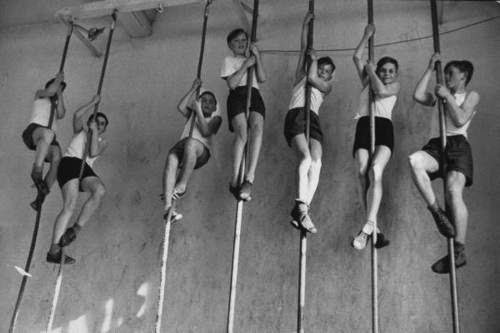
     And so, on inclement afternoons, we would don our tiny blue shorts and red T-shirts and march to the fetid gym for a torturous and humiliating round of rope climb or medicine ball. There, while some of us dangled, flailing and gasping from thick, coarse ropes, others would set upon one another with improbably heavy, leather covered bags of rocks while our teachers volubly questioned our budding manhood and rained insults down upon us. If it was a fine day, they would herd us out across Fifth Avenue and through Central Park for a run around the dreaded Reservoir. We might have just come off a nasty repast of fish-sticks or cod-balls and some of the weaker boys, with whom Big Bill invariably brought up the straggling rear, would drop like stones, skinning their knees on the cinder track while puking up their lunch. There seemed to be a tacit acceptance of my own pathetic running skills, as both the boys and the staff seemed to think that my size and presence might prevent the abject misfits from being culled out and ripped to pieces by the bandits and gangsters who lurked in the periphery like lions eying a herd of gazelle.


   One dusky, autumn afternoon the misconception of my prowess was played out as a group of us waited for the downtown bus at the stop on Fifth Avenue and 98th Street. We'd been there for a while and no bus had shown up, nor was there any sign of one as we stepped out into the street, craning to see as far uptown as possible. We were just discussing whether to wait or start walking when a gang of boys came over the Park wall like a boarding-party of pirates, armed with sticks and rocks, surrounding us in an instant and demanding our money and bus passes. One of my classmates spoke up, “ He's Big Bill. He'll protect us, won't you, Big Bill?” Before I could react, the biggest of the bandits calmly strolled over to a parked car, snapped the antenna off the fender, swished it about like a rapier and slashed me across the torso, leaving a three inch gash across the back of one hand. I dropped my bus pass, pivoted to the south and ran, leaving an astonished gaggle of little boys to fend for themselves in my wake. A few of the pirates lit out after me and I could hear their heavy breathing, interspersed with curses and threats, closing in. I ran across Fifth Avenue without looking, hoping that one of the doormen beneath the ubiquitous green awnings of the fancy building facing the Park might let me in.  One after another they barred their doors against me. I stumbled up the steps of The Church of the Heavenly Rest only to find the massive doors locked tight. By the time I passed the Metropolitan Museum I'd stopped looking over my shoulder altogether, afraid that would only slow me down with my pursuers right on my heels.


   Eventually, somewhere near the 72nd street entrance to the Park, I gave up and collapsed on a bench by the wall. There was no one chasing me. I wrapped my bleeding hand in my shirt tail and waited to catch my breath. I'd covered some twenty-six blocks – roughly the distance around the Reservoir – at a break-neck pace with apparently no straggling waifs left in my wake. I wondered briefly what might have become of them as I walked over to the Good Humor man, handed him the dollar I'd not given the gang of pirates and walked the rest of the way home chewing on a Candy Center Crunch.